This is a story that I decided to wait until I left Portugal to tell. Now that I am safely back in Canada, I will recount one of the more disturbing things that happened to me in Portugal, of which there are many.
One evening, after a night of drinking with friends in Barrio Alto, I brought home a guest, and we continued to have a few drinks on my terrace and then moved inside for some “private moments”. Soon after, there was a knock on the door, and to my surprise, there were two police officers standing at the door. One of the police officers spoke to me in perfect English, asking me, “Did I know what time it was?” I, being inebriated, said, “No, I did not.” He said, “Well, it is 2:00 a.m.” I said, “Well, what does that mean?” He said, “You’re not allowed to make any noise on your balcony after 10:00.” I said, “You mean the noise is too loud?” He goes, “No, you’re not allowed to make any noise on your balcony after 10:00. The door must be shut. You’re not supposed to be out there. You’re not allowed to make any noise. 10 pm is a hard cutoff.”
This didn’t surprise me very much because the Portuguese are very punctual and conformist. For example it is impossible to find food between the hours of 3:00 p.m. and 7:00 p.m. outside of touristy neighborhoods, or after 10pm for that matter. The entire city looks like a morgue after 10:00 p.m. and I had a eureka moment. “Oh, that explains a lot. I’m sorry, I had absolutely no idea. I come from a large city where everything was 24 hours.” I explained to the officer. “In Toronto, and the road construction noise starts around 11:00om because that’s when the traffic starts to die down a little bit. This was a case of culture shock, not malice. I didn’t anticipate noise controls, especially for talking on one’s own balcony. I thought I was allowed to do what I want on my balcony, but now that I know, it won’t happen again.”
He says, “Now that you know, hopefully it won’t disturb your neighbors again.” I said, “I strongly doubt it. Have a good night,” and went to go shut my door. The other police officer then prevented me from shutting the door by putting his foot in the door, and switched to Portuguese. The rest of the conversation consisted of me speaking in English and him speaking in Portuguese. If I didn’t understand something, the Portuguese speaking police officer refused to let the English-speaking police officer say a word to help me out.
He demanded in Portuguese that I show him ID, and I said, “I don’t need to show you ID. I’m in my own house.” I went to shut the door again, and his foot was in the door again. He got very, very upset, and I said, “You can be as upset as you want. I don’t have to show you any ID. You came for a noise complaint. The noise is finished. You can go now.”
He insisted that he was not leaving until he saw my ID, and I said to him, “Well, that’s fine. I would like to see your ID.” He asked, “Why would I want to see your ID?” I said, “Well, because you’re wearing a shirt that says ‘police,’ but I don’t see a badge number. I don’t see a name, so I don’t know what police department you’re coming from, but I will be making a complaint. Your foot should not be in my door. I did not invite you into my house. You do not have a warrant, so I’m opening up my door of my own volition. I don’t have to. You could have got those shirts that say police off Temu and this could be a home invasion. Show me some id.”
He refused, and he refused to remove his foot from the door. At that point, he started to get very irate that I was “forcing him to speak English” and telling me that I should go back to my own country. Being inebriated, I responded that his job was done the moment the noise complaint was done, and his harassing of immigrants was 100% volunteer on his own time, and that he should fuck off and harass somebody more easily intimidated. His face went beet red and he said, “You can’t tell a police officer to fuck off.” I said, “Well, I thought you didn’t speak English.”
He pulls out his handcuffs, and he asks me for my arms. The entire time that this is happening, by the way, my guest is sitting just behind a wall, barely dressed, terrified and embarrassed. There’s no way I want these two coming into my house.
In a moment of temporary brilliance, I cracked a big smile, and put on the best act of my life, pretending to be happy. He says, “Why are you happy?” He says, “I’m about to be arrested in my own home by an officer who’s entered my home without a warrant, who refuses to provide identification, and who seems to be arresting me for speaking English in my own home, and I have it all on camera.”, pointing to a security camera sitting on the desk. Little does he know that I have not bothered to install it yet. But my bluff works, the English-speaking cop gives him a terrified look, with his eyes wide like saucers, and says to him in Portuguese, “Let him go. Let’s get the hell out of here.” I was feeling very proud of what I had just done and told them that, no, they cannot take the elevator. Fascists can take the stairs, which they did. That said, the moment they were gone, all of that stress relief was released, and it did ruin my evening. I was quite upset about it for a very long time after.
I spoke to two separate lawyers, both of whom advised me that the police are corrupt and notoriously xenophobic and I’ll never find out who they were. They advised me very strongly not to make a complaint, because nothing at all will happen to the police, and it will just make me a target for further harassment.
I also brought this up with multiple Uber drivers, as Uber drivers very often are minorities and speak English. Every single Uber driver that I talked to admitted that they had had the exact same situation and that the police made it a regular occurrence to knock on the doors of people they consider foreigners and to make arbitrary arrests for no reason. They said that there was nothing one could do about it other than expect it to happen again.
I advised every Uber driver to get a camera, as the police seemed to be scared of being recorded. From then on I kept a camera pointed at the door, and I also posted a sign on my door to make them aware of the fact that, under European law, I’m allowed to record in my own house. The sign also advised them that this is an English-speaking house. Under European law, if an officers does not speak English, I have no right to force the officer to speak English, but I do have the right to a translator, and finally that entry is not granted without a warrant. That sign proved very useful to me over the years, as I was never harassed again, and I encourage anyone who is living in Portugal on a Temporary Residence Card to post this on their door for their own protection, along with a camera to back it up. I personally recommend Eufy cameras, they have served me very well in multiple situations.
Although I got myself out of a tricky situation that time and did not have to spend a night in a Portuguese prison, I never felt safe in Portugal ever again. I know that if ever I was targeted or attacked in Portugal, the police would never protect me, and many locals all confirmed this. Portugal is not only an extremely nationalistic and xenophobic place, it is also an unsafe place for Canadians who make their home in Portugal, you are not safe even in your own home.
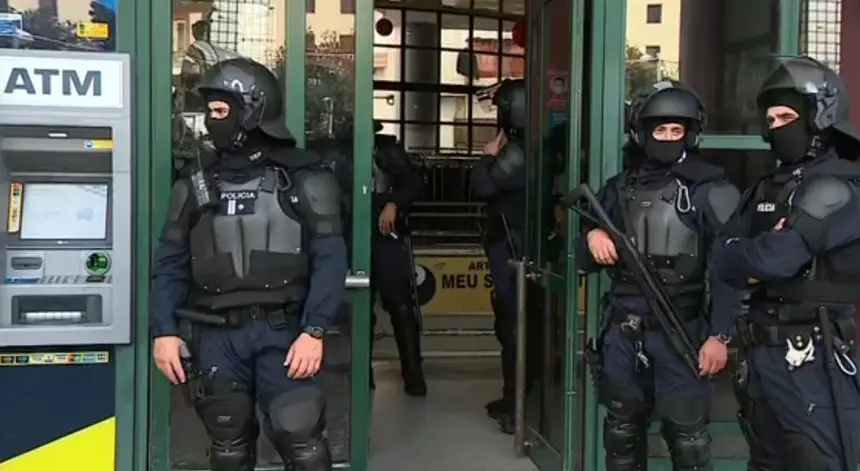
In the case of a violent attack, I have no faith that the police will come to my aid. It seems that every month I hear new stories of police officers brutally beating, raping and killing handcuffed immigrants, and brazenly boasting of their violent acts and sharing video on WhatsApp and other social media. They know that a majority of the population of Portugal cheers them on in this behaviour and that there will be no consequences. Amnesty International warned earlier this year of an “enormous sense of impunity” among police officers in Portugal, because in many cases victims of abuse are “too afraid to file a complaint”. I know exactly how that feels.